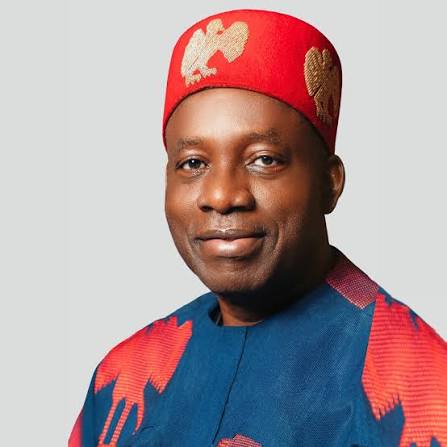

Gov. Chukwuma C. Soludo of Anambra State.
By Ebuka Ukoh
When Governor Charles Soludo directed traders in Anambra’s main markets to ignore the sit-at-home solidarity and resume normal six-days-a- week operations, many expected his government’s reassurances. They expected to hear a clear security plan. They expected to hear how lives and property would be protected. Instead, they saw the gubernatorial fiat.
This moment demands careful reflection. Not on who is right or wrong in the larger political contest. Not on who is defiant or compliant. But what government owes its people first.
Safety
Before a government asks people to defy the Monday sit-at-home and come out, it must convince them they are safe to do so. Before it demands economic activity, it must secure the environment in which that activity takes place. Orders without assurance do not build confidence. They deepen fear.
Nobody chooses to close shop on a market day. Nobody prefers to stay home when there is money to be made. Traders are not activists. They are survivalists. When they remain indoors, it is not ideology. It is a calculation. They measure risks against livelihoods and choose what keeps them alive. For once, picture the trader who has rebuilt her stall twice after previous violence. She is not weighing politics. She is weighing whether she will return home alive at the end of each market day. Picture another mother who packs her goods before sunrise and constantly prays not for profit, but simply to return home by dusk. The primary function of government is to protect lives and property. When that confidence is weak, no directive can replace it.
A directive that ignores this reality risks sounding detached from the daily experience of the people.
The first expectation should have been a detailed security strategy. Visible deployment. Community engagement. Clear communication. Collaboration with market unions. Assurance that enforcement agencies are present not only to compel but to protect. That is what earns trust. That is what gives courage to ordinary citizens.
Secondly, there is a constitutional dimension here. While a Governor has powers over public order and security within the State, private citizens retain the freedom to determine their economic activity within the bounds of the law. The Constitution protects liberty, movement, and enterprise. The government can regulate for safety. It cannot compel participation in commerce in a climate where people genuinely fear for their lives. Leadership persuades. It does not coerce.
Markets are not government offices. Traders are not civil servants. They are independent actors whose participation in economic life depends on confidence in public order.
If confidence is low, the response must be to raise confidence, not raise the tone of instruction.
The third issue is interest. Much has been said about the reported eight billion Naira lost for every Monday the markets remain closed. That figure is alarming. It shows the scale of economic pain. But it also reveals something deeper. It shows how much ordinary people lose when insecurity dictates behaviour.
If the people are already losing eight billion Naira out of fear, the real problem is not disobedience. It is fear. Consequently, fear has more authority than government.
Fear cannot be controlled by fiat
The interest of the people is not served by proving a point. It is served by removing the conditions that force them into silence. The interest of the people is not served by commands. It is served by confidence-building.
This moment calls for a different strategy. One that brings all aggrieved parties to the table.
One that recognises that this is no longer a simple matter of authority. It is a matter of legitimacy, trust, and dialogue. Sustainable peace rarely comes from force. It comes from engagement.
History shows that markets flourish where people feel protected, heard, and respected. Markets shrink where people feel exposed, dismissed, and compelled.
Governor Soludo is widely respected for his intellect and administrative experience. That is why many expected a solution driven by persuasion, negotiation, and system building. This situation offers an opportunity to demonstrate leadership that listens before it directs.
The people of Anambra State want to work. They want to trade. They want to earn. They want normalcy. They do not need to be told this. They need to be helped to achieve it safely.
The government must never appear to value economic optics above human security. Because when people feel that their safety is secondary to statistics, trust erodes quickly.
Leadership in times like these demands patience, consultation, and humility. It requires asking the people what they fear. It requires addressing those fears directly. It requires rebuilding confidence step by step. What if the Monday closure is in solidarity? Then, that should be respected and negotiated.
The path forward lies not in louder orders but in deeper engagements.
Markets do not reopen because they are ordered to. They reopen when people believe they will return home alive. That belief is the real work of the government. Until that confidence is restored, every command to “resume” sounds less like leadership and more like a gamble with other people’s lives.
That is the difference between authority and leadership. At this moment, Ndi Anambra need leadership, not authority.
Mr. Ukoh, an alumnus of the American University of Nigeria, Yola, and PhD student at Columbia University, writes from New York.